There are certain passages in the New Testament that pull against the grain. They seem to contradict a central teaching of Jesus, a central part of the gospel. But their purpose is not to negate that teaching but, instead, to balance it and place it in a clearer perspective. The issue in today’s parable is the difference between wisdom and foolishness and how we can distinguish between the two.
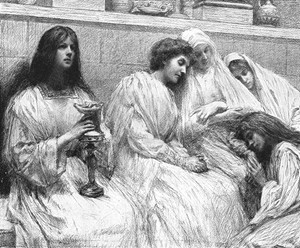
The Gospel story of the ten virgins is not about wedding customs or about charity or even about staying awake at night. Rather it is about being ready, being vigilant, paying attention – so that we never miss an opportunity to experience every moment of our lives to the fullest. All ten virgins are among the wedding party. The crucial difference between the two has nothing to do with staying awake, but with being wise enough to prepare for a possible emergency by having sufficient oil.
What does all of this mean for us? Discipleship involves more than simply being part of the wedding party. And our response must be that of watchfulness, not in the sense of neglecting the duties to which our Christian life calls us, but to the extent that each day must be one of attentiveness, expectation, and hope.
It is especially important to bring this message to the world today. In the United States we are entering an election season that clearly shows we are divided as a nation. Politicians will now all call us to unite, and unity is good. But unity does not mean that we all agree with one another. We hold radically different visions of the role of government, the definition of injustice, and the kind of country we think America should be.
It is not a message for Christians alone. It is one that suggests specific priorities that must be addressed by all peoples - the protection of human life, the promotion of family life and values, the quest for social justice and the pursuit of global solidarity. It is a matter of respecting life - all of life.
And while not promoting specific solutions, the message of Jesus asks some very pointed questions. Among them are:
- How will we protect the weakest in our midst-innocent, unborn children?
- How will we address the consequences of hunger, debt, and lack of development around the world?
- How can we raise our children with respect for life, sound moral values, a sense of hope, and an ethic of stewardship and responsibility?
- How will we address the growing number of families and individuals without affordable and accessible health care? How can health care protect and enhance human life and dignity?
- What are we doing to address the needs of migrants and refugees?
- How do we combat continuing prejudice, bias, and discrimination and heal the wounds of racism, religious bigotry, and other forms of discrimination?
- Why does it seem that our nation is turning to violence to solve some of its most difficult problems?
We are pilgrims in a changing world and there is, indeed, one absolutely essential element that all of us must share in common - keeping vigil and paying attention to this world and to others around us. We have a great opportunity to hold one another accountable to address the important moral issues that the world faces today.
Being a wise disciple implies that one has to make hard choices. Jesus tells us, "Be prepared, stay awake." Pay Attention. And if we are not prepared well, we may find ourselves locked out of the wedding banquet. And then it will be too late.
Image: The Ten Virgins - Eugène Burnand