Christian communities across the world will soon be gathering to proclaim their faith in the saving mystery of Christ's passion, death and resurrection. Each of the Gospel narratives that we will hear has its own unique perspective and one would expect the opening scenes of this holiest of weeks to be found in the garden of Gethsemane or in Pilate’s courtroom where Jesus receives his sentence, is then tortured and taken off to Calvary for his execution.
 Matthew's Passion account begins with a long narrative about Jesus and his disciples at the Last Supper and judging from the goings-on around that table we can imagine that Jesus’ passion begins here. Christ’s passion was much more than the brutal, physical suffering he was made to endure. His was also a passion of discouragement, frustration and failure.
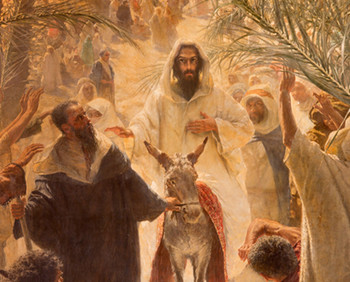
After being with him for three years his disciples seem to have no clue about who Jesus was and still didn’t understand what he had been teaching them about service and sacrifice for the sake of the kingdom of God. They would rather stay imprisoned in their own notions of God and holiness and of what’s right and wrong. As they entered Jerusalem to the cheers and songs of the crowds, they still totally missed the point.
Jesus is the “suffering servant” of Isaiah who speaks to a people enslaved and in exile. He assumes their weakness and failure and willingly takes on their pain and suffering. But despite the agony and death that will mark the end of this week, he remains faithful to his mission. The passion of Christ concretely speaks the words of Isaiah: "I gave my back to those who beat me, my cheeks to those who plucked my beard, my face I did not shield from buffets and spitting."
There are lessons to be learned here. The Passion of Christ reminds us that we’re not just recalling the past. Our experience of the Passion must affect our present and our future. Daily we are witnesses to the inhumanity of war in the Ukraine and the constant stories of death and destruction in the Middle East. We have become almost immune to stories of innocent people suffering and dying because they stand up against oppression and bigotry. And we all suffer from the pressures of political, economic and social systems which drain our energy and suffocate our faith. Good people are crucified every day.
But what we need to remember most of all is that our faith in the Resurrection doesn’t quickly rush to “solve” the pain we experience in our lives. It is true that we need to identify with the loss and bewilderment of the disciples because very often we are also left with unanswered questions. Still, we must always identify with Jesus, receiving strength from his endurance under his own passion.
Jesus comes to us when our hope is shattered and we want to walk away. He comes to us in the poor and the sick and the frightened and the lonely. He comes to us when we grow weak and stumble and he lifts us up with the assurance that he will stay with us through the valley of death until we, too, will rise with him to the fullness of life.